Blog
Do Water Filter Pitchers Actually Remove Microplastics?
By Timothy Dunbar · · 5 min read · Updated
Water filter pitchers are cheap, familiar, and sit on countertops in millions of kitchens. Whether they do anything about microplastics specifically is a narrower question than "does it filter water," and until recently it hadn't been tested carefully. A 2023 University of Toronto study did exactly that — and the results explain why this site keeps pointing back to certifications instead of marketing copy.
The study
Engineering researchers tested three pour-through point-of-use filter devices — the pitcher-style filters common in North American kitchens — by spiking tap water with PET fragments, PVC fragments, and nylon fibers spanning 30 to 1,000 micrometers, then measuring what came out the other side (Cherian et al., 2023, Polymers). The devices weren't named by brand, but their filtration technology was: one combined granular activated carbon (GAC) with ion exchange (IX) resin and nothing else; the other two added a physical microfiltration membrane, at 0.2 and 1 micrometer nominal pore size.
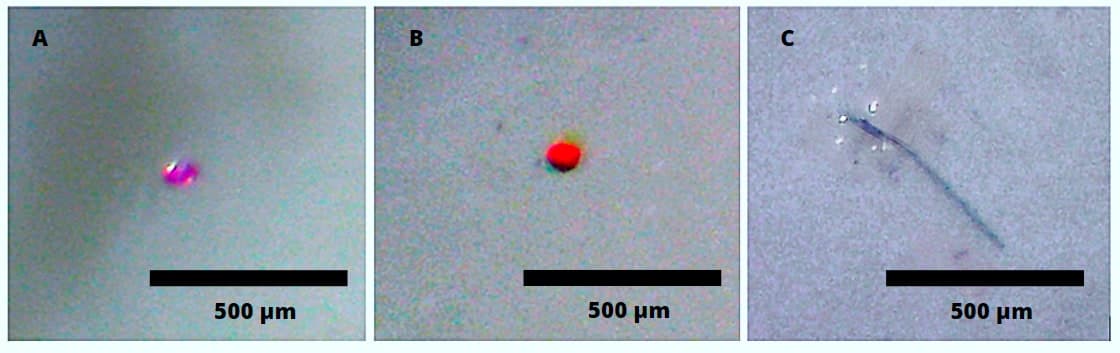
The results split cleanly along that technological line.
Loose carbon and resin weren't enough — and made things worse
The device relying only on GAC and ion exchange, with no membrane barrier, didn't just fail to remove particles — the researchers found more microplastic fragments in the filtered water than in the water going in.
Where those extra particles came from is worth being careful about, because the paper doesn't say. It reports the observation and offers no mechanism, and it does not polymer-type the particles in that device's effluent. Reasoning from materials, ion exchange resin is typically polystyrene-divinylbenzene — a plastic, and a plausible source. Activated carbon isn't plastic at all, so carbon fines shed from the media wouldn't count as microplastic even if they were shedding. The device's own plastic housing and fittings are another candidate. On this study's evidence, all of those remain hypotheses.
Devices that added a microfiltration membrane performed far better: 94–100% removal of PET fragments and 78–86% removal of PVC fragments, with the best results coming from the device with the smallest membrane pore size (0.2 micrometers, versus 1 micrometer in a weaker-performing model). The pattern was consistent with basic physics — a membrane with pores smaller than the particles will catch them; ion exchange and carbon adsorption, which target dissolved chemicals rather than solid particles, won't.
Not all carbon filters are the same
One distinction this study doesn't make, and that matters when you go shopping: granular activated carbon and carbon block are not interchangeable.
GAC is loose granules with flow channels between them. Water takes the path of least resistance around the grains, so there is no meaningful mechanical barrier — which is the configuration tested here. A carbon block is that same carbon compressed with a binder into a solid wall, and it carries a nominal pore rating, commonly 0.5 to 5 micrometers. That is a physical barrier, and it will exclude particles larger than its rating.
So "carbon doesn't remove microplastics" is too broad a claim. Carbon adsorption doesn't. A carbon block's pore structure can, and carbon blocks are common in under-sink and countertop systems even though loose GAC dominates the cheap pitcher category. What matters is whether the filter puts a fine enough physical barrier in the particle's way — not what the medium is made of.
Why this matches what we already tell you about certifications
This is exactly the mechanism NSF/ANSI 401 certification is meant to verify: a real, tested reduction claim tied to a specific contaminant class, rather than a "filters everything" marketing line. A pitcher that's just loose granular carbon and resin — most budget pitchers, historically — has no particular reason to catch particles, and per this study, may add some. A pitcher whose filter is independently certified for microplastics reduction (like the Brita Elite filter, which carries NSF/ANSI 401 microplastics certification) has passed a real removal test, not just plausibility.
The practical rule from this study: check what physically stops the particle, not what the box says. Adsorption changes taste and reduces some dissolved chemicals; only a fine enough physical barrier — a membrane, a carbon block with a tight pore rating, or reverse osmosis at the more thorough end — reliably removes suspended microplastic fragments.
What this doesn't tell us
A few limits worth being honest about: the study used spiked particles at controlled sizes, not necessarily representative of the full range of shapes and polymers found in real tap water, and it tested three devices, not the full market. It tested loose GAC, so it says nothing about how a compressed carbon block would perform. It doesn't identify what the extra particles from the GAC and resin device actually were, which leaves the most interesting result unexplained. And it's silent on nanoplastics — particles below the micron range that even a 0.2-micron membrane wouldn't catch, and that require reverse osmosis or finer methods to meaningfully address.
The takeaway
If microplastics reduction specifically is a goal, skip pitchers that only advertise "granular activated carbon" and look for one of two things: NSF/ANSI 401 certification (the emerging-contaminants category that covers microplastics) or a reverse osmosis system, whose membrane pore size is far below anything in this study's particle range. A carbon block with a stated sub-micron rating is a reasonable third option, though it wasn't what this study tested. We break down specific certified options in our water filter guide.
Updated 10 August 2026: corrected an over-broad claim that carbon filtration cannot catch particles — that holds for loose granular carbon, not for compressed carbon block, which has a real pore rating. Also removed a statement that the carbon and resin media "likely shed their own particles," which the paper does not establish; it reports the increase without identifying a source. Thanks to a reader on r/microplastics for both.
This article describes research findings and general information, not personalized health advice.
Frequently asked questions
Do water filter pitchers remove microplastics?
It depends entirely on the filtration technology. A 2023 study found pitchers using only granular activated carbon and ion exchange resin actually released more microplastic particles than the water going in. Pitchers with an added microfiltration membrane removed 94–100% of PET fragments and 78–86% of PVC fragments.
Can a water filter pitcher add microplastics to water?
Yes, according to that same study — a carbon-and-resin-only device showed a higher particle count in its filtered output than in the unfiltered tap water, likely from the filter media itself shedding particles.
What should I look for in a pitcher if I want microplastics removal?
NSF/ANSI 401 certification, which specifically tests for microplastics reduction, or a physical barrier fine enough to exclude particles — a membrane well below 1 micron, or reverse osmosis. Note that not all carbon is equivalent: granular activated carbon is loose granules with flow channels between them and no real mechanical barrier, while a compressed carbon block carries a nominal pore rating (commonly 0.5–5 micron) and does filter physically.