Guide
What Are Microplastics? A Plain-English Guide
By Timothy Dunbar · · 5 min read
If you've read a headline about plastic being found in drinking water, table salt, or human blood, you've read about microplastics. The term gets used loosely, so it's worth pinning down what scientists actually mean by it — and what they don't.
The definition
Microplastics are plastic particles smaller than 5 millimeters in their longest dimension. That's roughly the size of a sesame seed and smaller — down to particles you'd need a microscope to see. The 5 mm cutoff is a convention that emerged from marine research in the 2000s and has since been adopted widely by researchers and agencies, including the U.S. National Oceanic and Atmospheric Administration (NOAA National Ocean Service).
Below the micro scale, researchers increasingly distinguish nanoplastics — particles smaller than 1 micrometer (a thousandth of a millimeter). Nanoplastics are harder to detect and measure, which is one reason so much about them remains uncertain.
A few things microplastics are not:
- They are not a single substance. "Microplastic" describes a size range, not a material. A polyester fiber from a fleece jacket, a fragment of a weathered bottle cap, and a bead of polyethylene are all microplastics made of different polymers with different properties.
- They are not always visible. Much of what researchers count in water and air samples is far too small to see.
- They are not automatically toxic at any dose. Whether and how they harm human health is an active area of research — we cover the evidence carefully in our health effects guide.
Primary vs. secondary microplastics
Researchers sort microplastics into two categories based on how they originate.
Primary microplastics
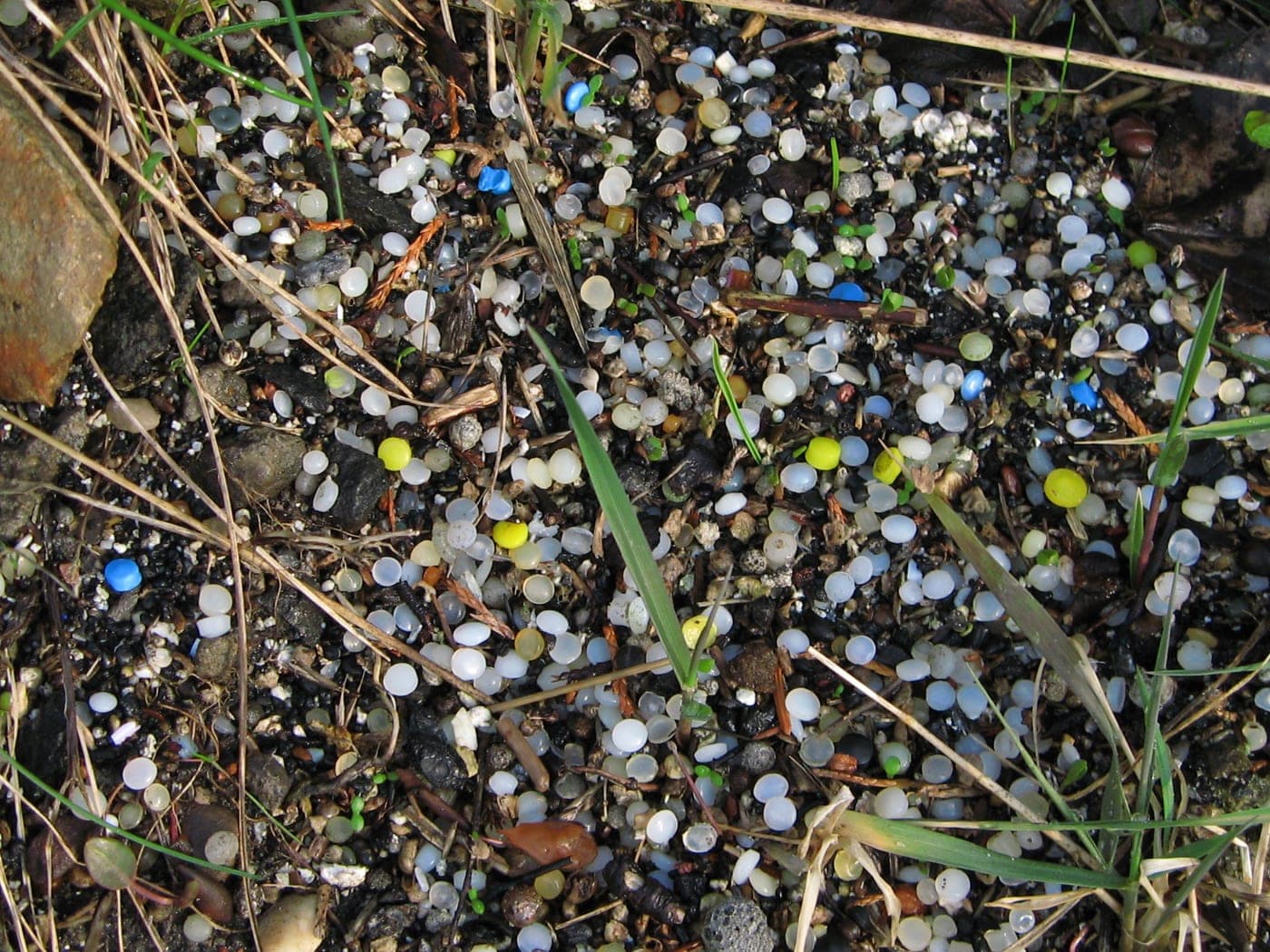
Primary microplastics are manufactured small on purpose. They enter the environment already in the micro size range. Examples include:
- Plastic pellets ("nurdles") — the raw feedstock of the plastics industry, shipped by the ton to factories that melt them into products. Spills during transport and handling are a well-documented source of pellet pollution on beaches (Boucher & Friot, IUCN, 2017).
- Microbeads — tiny polyethylene spheres once common in exfoliating scrubs and toothpaste. Many countries have banned them in rinse-off cosmetics; the United States did so with the Microbead-Free Waters Act of 2015 (FDA).
- Industrial abrasives and powders used in blasting, molding, and other processes.
Secondary microplastics
Secondary microplastics start life as larger plastic items and fragment over time. Sunlight (UV radiation), heat, mechanical stress, and abrasion make plastic brittle and break it into ever-smaller pieces. This category is believed to make up the large majority of microplastic pollution in the environment — IUCN's global source analysis attributes only 15–31% of ocean microplastics to primary sources (Boucher & Friot, 2017). Common examples:
- Fragments of bottles, bags, and packaging weathering outdoors
- Synthetic textile fibers shed when polyester, nylon, and acrylic fabrics are washed and worn
- Tire wear particles abraded from tires onto roads and washed into waterways
- Paint flakes from buildings, road markings, and ship hulls
The key insight: plastic doesn't biodegrade the way organic material does. It mostly just gets smaller. A plastic bottle doesn't disappear over centuries — it becomes thousands of fragments that are far harder to clean up than the original bottle.
Why size matters
The size of a plastic particle changes almost everything about how it behaves:
Where it goes. Larger fragments sink or float depending on the polymer's density, while the smallest particles can travel enormous distances. Microplastics have been documented in deep-sea sediment, Arctic sea ice, mountain air, and rainfall in remote wilderness areas — one study measured daily microplastic deposition in a pristine Pyrenees catchment far from any city (Allen et al., 2019, Nature Geoscience).
What can ingest it. As particles get smaller, more organisms can take them in — from whales down to zooplankton at the base of the food web. For humans, particle size influences whether an ingested or inhaled particle simply passes through the body or can potentially cross biological barriers. Most ingested microplastic is believed to be excreted; the open questions concentrate on the smallest particles (EFSA, 2016, EFSA Journal).
Whether we can measure it. Detection methods have practical lower limits. Many widely cited studies could only count particles down to a few micrometers, which means reported concentrations are often undercounts of the true total — a major reason estimates of human exposure vary so widely between studies.
How much is out there?
Precise global numbers don't exist, but the scale is large by any accounting. Estimates suggest millions of tons of plastic enter the ocean each year, and microplastics have been found in essentially every environment researchers have looked: seawater and freshwater, agricultural soil, indoor and outdoor air, and food and beverages including salt, seafood, honey, and drinking water (Cox et al., 2019, Environmental Science & Technology).
Bottled water is a frequently studied example. A 2018 analysis of 259 bottles across 11 brands found microplastic in 93% of samples, at an average of around 325 particles per liter — roughly twice the levels the same team found in tap water (Mason et al., 2018, Frontiers in Chemistry).
For a fuller tour of the sources that matter most in daily life — textiles, tires, packaging, tea bags, and more — see where microplastics come from.
The honest summary
Three things can be true at once, and the evidence suggests they are:
- Microplastics are everywhere. Their presence in water, food, air, and human tissue samples is well documented.
- Human health effects are not yet established. Detection is not the same as demonstrated harm. Regulators including the World Health Organization have called for better data rather than declaring a crisis (WHO, Microplastics in drinking-water, 2019).
- Reducing exposure is reasonable and usually cheap. Many of the most effective steps — filtering tap water instead of buying bottled, not heating food in plastic — cost little and have other benefits regardless of how the health research resolves.
That's the framing this site tries to keep: no alarmism, no dismissal, just what's known, what isn't, and what you can practically do.
Frequently asked questions
What exactly are microplastics?
Plastic particles smaller than 5 millimeters in their longest dimension — roughly a sesame seed and smaller, down to particles only visible under a microscope. The 5mm cutoff is a convention adopted from marine research and used widely by agencies including NOAA.
What is the difference between primary and secondary microplastics?
Primary microplastics are manufactured small on purpose, like plastic pellets or cosmetic microbeads. Secondary microplastics start as larger items — bottles, textiles, tires — that fragment over time from sunlight, heat, and abrasion. Secondary sources are believed to make up the large majority of microplastic pollution.
What is the difference between microplastics and nanoplastics?
Microplastics are under 5 millimeters; nanoplastics are a further size class below 1 micrometer (a thousandth of a millimeter). Nanoplastics are harder to detect and measure, which is part of why so much about them remains scientifically uncertain.