Microplastic Defense

Amazon links on this page are affiliate links — as an Amazon Associate I earn from qualifying purchases. Details

Best Air Purifiers for Airborne Microplastics

Indoor air is the exposure route people think about least and breathe the most. Fiber counts measured inside homes and offices run between 1 and 60 per cubic metre, against 0.3 to 1.5 outdoors — a house isn't filtering the outside world so much as generating its own supply from carpet, curtains, upholstery, and the clothes on your back. A study that sampled the breathing zone of ordinary apartments with a breathing manikin found 9.3 microplastic particles per cubic metre, 81% of them polyester.

A 2025 analysis in PLOS ONE pushed those numbers much higher by resolving smaller particles than earlier work could see: a median of 528 particles per cubic metre in homes, 94% of them between 1 and 10 microns, and roughly 68,000 particles in that size range inhaled per adult per day. The same study measured car cabins at a median of 2,238 particles per cubic metre — several times worse than any room in a house.

The useful part: this is an ordinary filtration problem with an ordinary answer. True HEPA is certified to capture at least 99.97% of particles at 0.3 microns, and 0.3 microns is close to the hardest size for a fibrous filter to trap — particles both larger and smaller are caught more efficiently. Indoor microplastics are measured at 1 micron and up, and fibers run to hundreds of microns, so a standard True HEPA filter is already well past what this job requires. What you're really buying is air changes per hour.

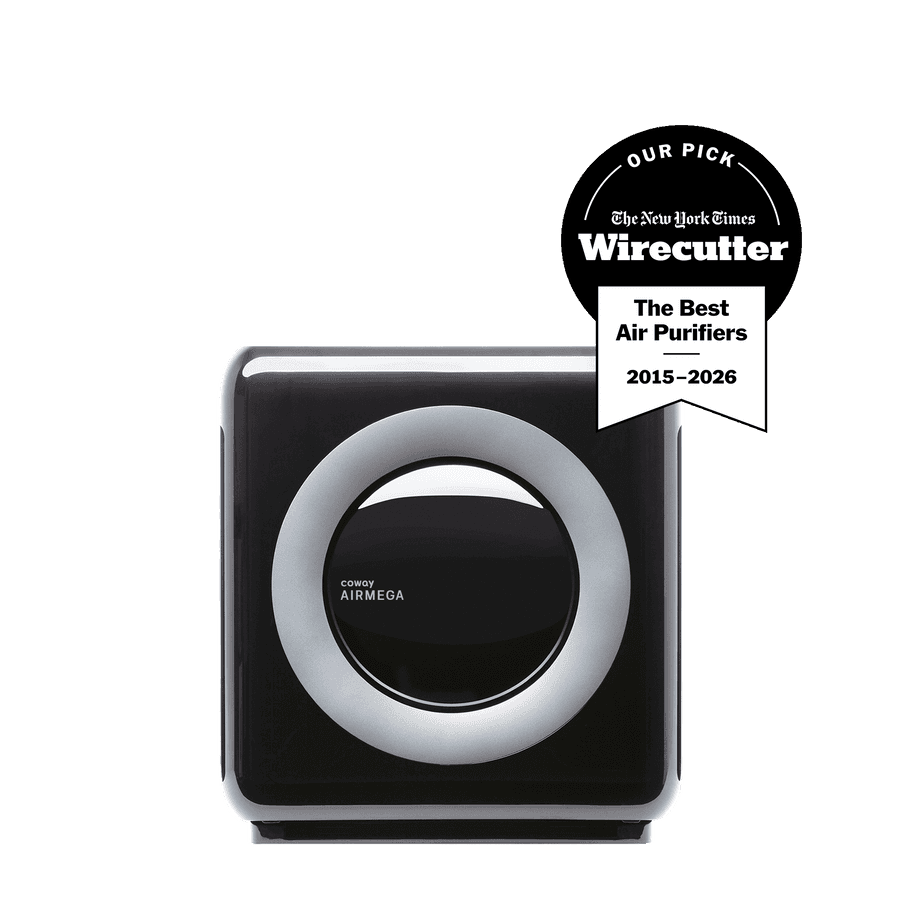
Coway Airmega AP-1512HH Mighty air purifier in black, front view, with the manufacturer's Wirecutter "Our Pick — The Best Air Purifiers 2015–2026" award badge in the corner
Best overall

Coway Airmega AP-1512HH Mighty

The default recommendation in this category for a decade — Coway's own image carries Wirecutter's top-pick badge for 2015 through 2026 — and it's the right size for the room most people actually want to treat. Three filtration stages plus a particle sensor that ramps the fan when the air gets dirty.

Key specs
  • Type: portable True HEPA purifier with washable pre-filter and activated carbon stage
  • AHAM-verified CADR: 246 dust / 240 pollen / 233 smoke
  • Coverage: 361 sq ft at 4.8 air changes/hour (the manufacturer's 1,748 sq ft headline is at 1 ACH)
  • 24–53 dB across five speeds; HEPA filter ~1 year, carbon filter ~6 months

Pros

  • Enough clean-air delivery to genuinely turn over a bedroom or living room several times an hour
  • Auto mode reacts to the particle sensor, so it spins up during the activities that shed most — folding laundry, making the bed, vacuuming
  • Washable pre-filter catches the coarse lint and fiber load, which is most of the visible fiber mass, and extends HEPA life
  • Enormous owner base: filters, parts, and help are trivial to find

Cons

  • Carbon deodorization filter is a separate consumable on a shorter clock than the HEPA
  • The headline square-footage figure is at one air change per hour — treat 361 sq ft as the real number
  • Includes a bipolar ionizer; leave it off, since it adds nothing to particle capture and ion generators can produce ozone
  • Moulded plastic housing, like almost every purifier in its class
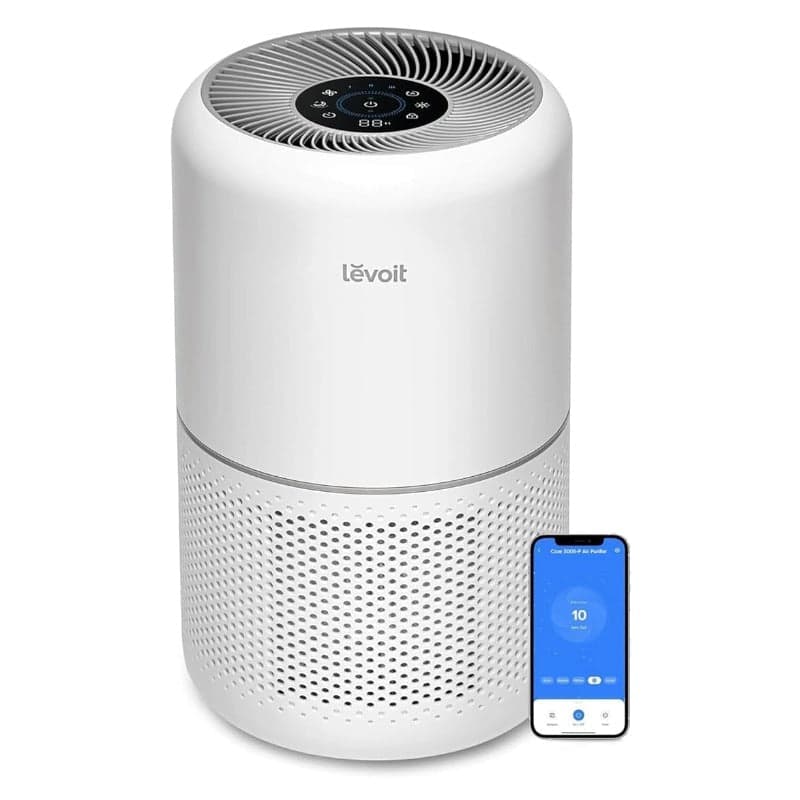
LEVOIT Core 300S-P smart air purifier, white cylindrical tower, front view
Best for a bedroom

LEVOIT Core 300S-P Smart Air Purifier

The cheapest purifier we'd call credible: a genuine H13 True HEPA cartridge in a small cylinder quiet enough to run beside your head all night. A bedroom is where you breathe the same air for eight uninterrupted hours, which makes it the highest-value room to treat first.

Key specs
  • Type: portable purifier, 3-stage — pre-filter, H13 True HEPA (99.97% at 0.3 microns), activated carbon
  • CADR: 141 CFM (240 m³/h)
  • Coverage: 219 sq ft at 4.8 air changes/hour (1,051 sq ft at 1 ACH)
  • 22–50 dB; combined filter lasts 6–8 months; app scheduling and Alexa/Google control

Pros

  • H13 True HEPA at the lowest price that still means something
  • 22 dB on sleep mode — quiet enough that it actually stays on overnight
  • Small footprint and light enough to move between rooms
  • One inexpensive cartridge covers all three stages

Cons

  • 219 sq ft at a useful air-change rate: a bedroom or study, not an open-plan floor
  • The 3-in-1 design means you replace the carbon and the HEPA together whether or not both are spent
  • Smart features require the VeSync app and an account
  • Plastic housing, and the pre-filter is part of the disposable cartridge rather than washable
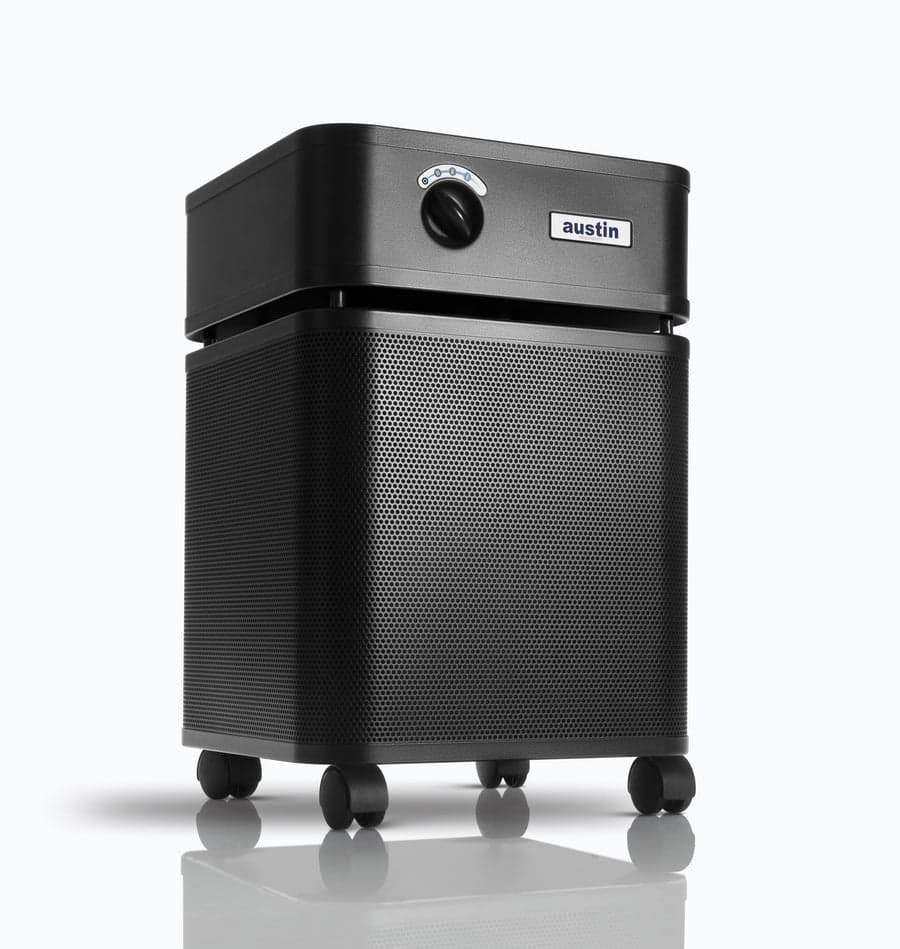
Austin Air HealthMate B400 air purifier in black, showing the perforated steel housing
Best built

Austin Air HealthMate B400

The one purifier on this page that isn't a plastic box. A powder-coated steel cabinet with a 360° perforated steel intake, 15 lb of activated carbon and zeolite, and a medical-grade HEPA rated for five years — handcrafted in Buffalo, New York. Bought once, fed rarely.

Key specs
  • Type: portable purifier, 4-stage — two pre-filters, carbon/zeolite bed, medical-grade HEPA
  • Filtration: 99.97% of particles at 0.3 microns, 99% at 0.1 microns; 60 sq ft of HEPA media
  • Solid steel housing with powder-coat finish and 360° perforated steel intake
  • Filter rated 5 years; 5-year mechanical warranty; 47 lb, 14.5 × 14.5 × 23 in

Pros

  • Steel construction rather than the moulded plastic shell every competitor uses — the obvious choice if the point is having less plastic in the house
  • Five-year filter life ends the annual replacement habit entirely
  • The 15 lb carbon and zeolite bed also absorbs the VOCs that offgas from plastics and furnishings, which no thin carbon sheet manages
  • 360° intake means placement is forgiving, and the whole thing is built to outlive several plastic purifiers

Cons

  • Costs several times the Coway, and the eventual filter is expensive too
  • 47 lb on casters — this is furniture, not something you carry upstairs
  • No sensor, no auto mode, no app: a three-speed dial and nothing else
  • Loud at the top speed, and the size and looks are industrial
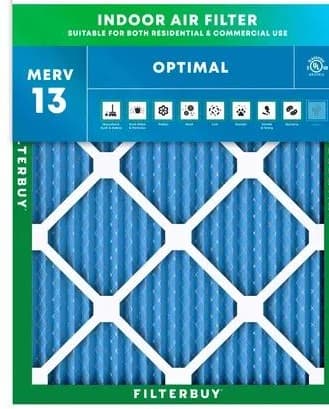
Filterbuy MERV 13 pleated furnace filter, blue pleated media in a green cardboard frame
Best whole-home value

Filterbuy MERV 13 Furnace Filter (20×25×1, 2-pack)

If you have ducted heating or cooling, the cheapest large win isn't a purifier at all — it's putting a MERV 13 filter in the return you already have and running the fan. It treats every room the ductwork reaches, takes no counter space, and makes no noise.

Key specs
  • Type: 1-inch pleated HVAC return filter, MERV 13, electrostatic synthetic media, made in the USA
  • MERV 13 minimums under ASHRAE 52.2: ≥90% capture at 3–10 microns, ≥85% at 1–3 microns, ≥50% at 0.3–1 micron
  • Replace every ~90 days
  • This listing is 20×25×1 (actual 19.50 × 24.50 × 0.75 in); the same filter is sold in every common size

Pros

  • MERV 13 is strongest exactly across 1–10 microns, the band holding ~94% of the microplastics measured in indoor air
  • Filters the whole house through equipment you already own and pay to run
  • Costs a small fraction of a portable purifier per square foot covered
  • Nothing to place, plug in, or listen to — it's a drop-in swap

Cons

  • Only filters while the blower is running: set the thermostat fan to "on" or a circulate mode, or it does nothing between heating and cooling calls
  • MERV 13 restricts airflow more than a cheap filter — check your system's tolerance, since older or undersized equipment can suffer
  • No use at all without ducted HVAC (radiators, baseboard heat, mini-splits)
  • Measure your return before ordering; a loose filter lets air bypass it entirely

Before you buy

You don't need a "microplastic" air purifier

HEPA is certified at 0.3 microns because that size is close to the worst case for a fibrous filter; efficiency rises for particles both larger and smaller. Indoor microplastics are measured from about 1 micron up, and fibers run to hundreds of microns, so a plain True HEPA filter catches them at better than its rated 99.97%. A purifier charging a premium for microplastic-specific filtration — or advertising capture down to 0.003 microns — is not catching anything a standard True HEPA misses.

On furnace filters, compare MERV and ignore the rest

MERV is the industry rating, defined by ASHRAE 52.2 and comparable across every brand. "MPR" is 3M's own in-house number and "FPR" is Home Depot's — both are proprietary scales that exist mainly to make cross-shopping harder. MERV 13 is the sweet spot for a home system: strong across the 1–10 micron band without the airflow penalty of MERV 14 and up.

Buy air changes per hour, not square footage

Manufacturers usually headline the room size their unit can handle at one air change per hour, which is far too slow to matter against a source that keeps shedding. Aim for 4–5 air changes: multiply the CADR in CFM by 60, then divide by your room's volume in cubic feet. As a shortcut, take the advertised square footage and divide by about four.

Your car may be the worst room you use

The 2025 PLOS ONE measurements found a median of 2,238 microplastic particles per cubic metre in car cabins against 528 in homes — a small sealed space lined almost entirely in synthetic textile and plastic trim. Cabin air filters are vehicle-specific so we don't recommend one here, but replacing yours on schedule is the highest-yield filter change most people never make. Ignore the plug-in car "purifiers" sold alongside them; most are ionizers with no meaningful filtration.

Filtration is the second step, not the first

A purifier only removes what is already airborne. Shedding less in the first place does more: fewer synthetic textiles in heavy-wear places, damp-dusting and damp-mopping rather than dry methods that re-aerosolize settled fiber, and a vacuum with a genuinely sealed HEPA path rather than one that blows fine dust back into the room.

Related reading