Guide
Where Microplastics Come From: The Major Sources
By Timothy Dunbar · · 6 min read
Microplastics don't come from one place — they leak into the environment from dozens of routes, and into your body from a shorter, more personal list. This guide covers both: the big environmental sources, and the everyday items most relevant to your own exposure.
The big environmental sources
Global estimates differ in their rankings, but a handful of categories dominate most analyses of microplastic releases (Boucher & Friot, IUCN, 2017).
Synthetic textiles
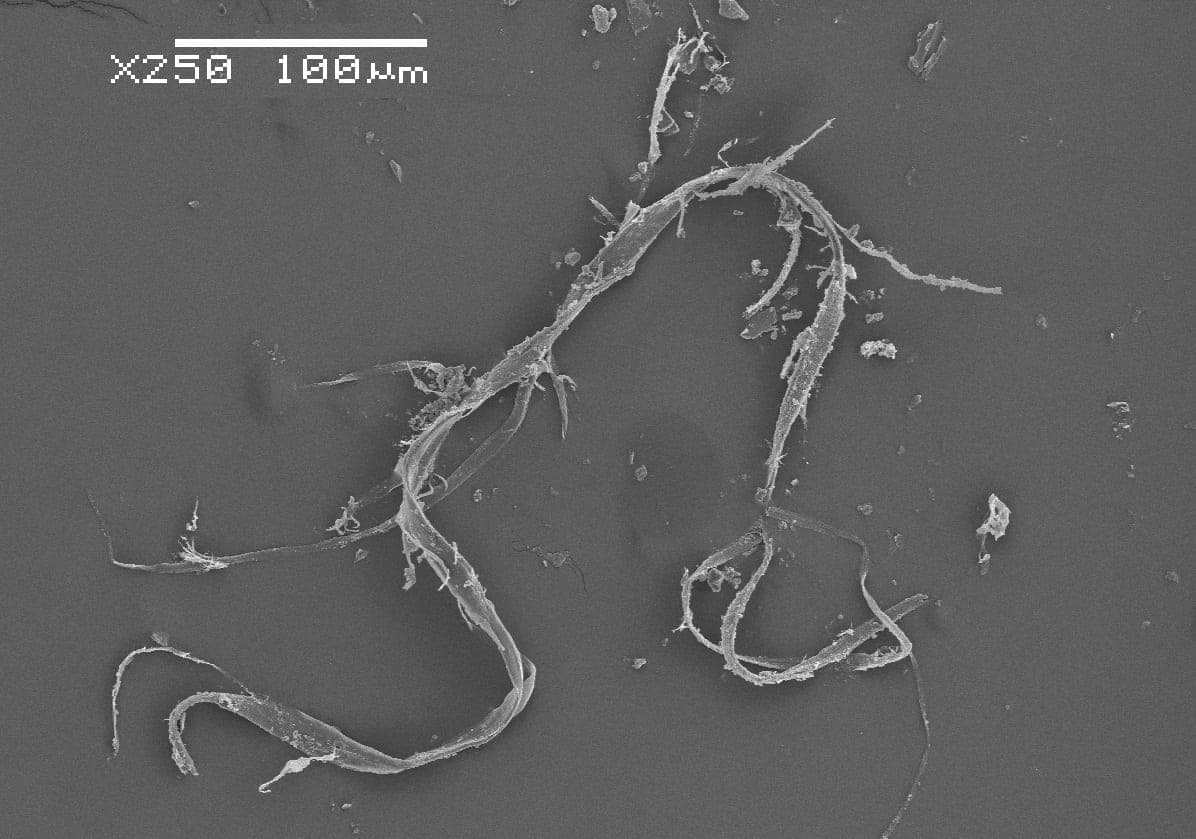
Roughly two-thirds of modern clothing contains synthetic fibers — polyester, nylon, acrylic, elastane. Every wash mechanically stresses these fabrics, and studies suggest a single load of laundry can release hundreds of thousands to millions of microscopic fibers into wastewater — over 700,000 fibers from a typical 6 kg acrylic load in one widely cited experiment (Napper & Thompson, 2016, Marine Pollution Bulletin). Treatment plants capture a large share, but the sheer volume means fibers still reach rivers and oceans — and the captured portion often ends up in sewage sludge spread on farmland.
Fibers also shed during ordinary wear, contributing to indoor dust. Fleece and other brushed fabrics are particularly prolific shedders. This is the source category you have the most direct control over: washing synthetics less often, colder, and in fuller loads reduces shedding, and microfiber laundry filters can catch much of the rest.
Tire wear
Every kilometer driven abrades a little rubber-and-polymer mixture off your tires. Multiply by more than a billion vehicles and tire wear becomes one of the largest sources of microplastic pollution by mass — some analyses rank it first (Kole et al., 2017, Int. J. Environ. Res. Public Health). The particles wash off roads into waterways and become airborne near traffic. A specific tire-derived chemical, 6PPD-quinone, has been linked in published research to salmon die-offs in stormwater-affected streams (Tian et al., 2021, Science).
There's little an individual can do here beyond driving less and driving smoothly; this is a source that will be addressed, if at all, by tire formulation and stormwater policy.
Packaging and litter fragmentation
Single-use packaging is the most visible plastic waste stream. Bags, films, bottles, and wrappers that escape collection weather in sunlight and fragment into secondary microplastics for decades. Beach and river surveys consistently find packaging-derived fragments among the most common debris categories — a global classification of ocean litter found takeout food and drink items dominate (Morales-Caselles et al., 2021, Nature Sustainability).
Paint, pellets, and agriculture
Three less-famous but significant sources: paint flakes from ships, road markings, and buildings (marine coatings are a major contributor in some estimates); pre-production pellet spills during industrial transport and handling; and agricultural plastics — mulch films and greenhouse sheeting that fragment directly into soil, plus sewage sludge fertilizer carrying laundry fibers full circle back to fields. IUCN's source analysis quantifies marine coatings and pellet losses among the major primary categories (Boucher & Friot, 2017).
The sources closest to your mouth
Environmental rankings tell you where pollution comes from. Personal exposure has its own ranking, and several everyday items punch far above their weight.
Bottled water
One of the most consistent findings in the field: bottled water carries more microplastic than tap water. A 2018 study across 11 major brands found an average of about 325 particles per liter, with some bottles in the thousands (Mason et al., 2018). A 2024 study using newer detection methods reported roughly a quarter of a million particles per liter when counting nanoplastics (Qian et al., 2024, PNAS). The particles appear to come from the bottles and caps themselves, with bottle reuse and heat making it worse.
The practical takeaway is unusually clean: drinking filtered tap water instead of bottled water likely cuts your single largest controllable microplastic intake — and saves money. Not every filter delivers on that, though: a 2023 test of pitcher-style filters found some designs actually added particles rather than removing them (Cherian et al., 2023, Polymers; our breakdown of that study). See our water filter reviews for which certifications actually mean something.
Plastic tea bags
In 2019, researchers found that a single plastic (nylon or PET) tea bag steeped at 95 °C released billions of micro- and nanoparticles into a single cup (Hernandez et al., 2019, Environmental Science & Technology). "Premium" pyramid-style mesh bags are the usual culprits; many paper tea bags also use a small amount of plastic sealant. Loose-leaf tea in a stainless infuser sidesteps the issue entirely. We dig into this study in our tea bag article.
Heated plastic: kettles, containers, and takeout
Heat is the great accelerator of particle release. Studies have measured substantial microplastic release from plastic kettles during boiling (Shi et al., 2022, Journal of Hazardous Materials) and from plastic containers and pouches during microwaving — billions of particles per square centimeter in three minutes of heating (Hussain et al., 2023, Environmental Science & Technology; our full breakdown of that study). As a rule of thumb, the higher the temperature and the older/more scratched the plastic, the more it sheds. This is why "stop heating food in plastic" tops nearly every practical recommendation list, including ours: see kitchen swaps.
Indoor dust and air
Indoor air typically carries more microplastic fibers than outdoor air — shed from clothing, carpets, curtains, and furnishings (Dris et al., 2017, Environmental Pollution). Some estimates suggest inhalation and dust ingestion may rival food as an exposure route, particularly for toddlers, who live close to the floor and put their hands in their mouths. A 2025 study that resolved finer particles than earlier methods reported a median of 528 particles per cubic metre indoors — and 2,238 in car cabins, the most contaminated everyday space it measured (Yakovenko et al., 2025, PLOS ONE). Regular vacuuming (ideally with a HEPA filter), damp dusting, and ventilation are the mundane but sensible responses; a True HEPA purifier in the room you sleep in is the one piece of equipment worth adding (which ones, and how to size them).
Salt, seafood, and other foods
Sea salt frequently contains microplastic, unsurprisingly, since it's evaporated seawater — over 90% of salt brands sampled worldwide tested positive (Kim et al., 2018, Environmental Science & Technology; our full look at the salt studies). Shellfish eaten whole — mussels, oysters — deliver whatever particles the animal accumulated. Detected quantities in foods are generally small compared to the water and dust routes, so these are worth knowing about but rarely worth anxiety.
Chewing gum
Gum base is a polymer whether it's marketed as synthetic or "natural" — a 2025 UCLA pilot study found both types shed similar amounts of microplastic into saliva during chewing, averaging around 100 particles per gram (UCLA, 2025). It's a small contributor next to water and heated plastic, but a good reminder that "natural" labeling doesn't automatically mean plastic-free.
Cosmetics and microbeads
The famous source that's now mostly historical: rinse-off cosmetic microbeads have been banned in the U.S., U.K., and elsewhere (FDA). Some leave-on products and glitters still contain intentionally added microplastics, and regulations (notably the EU's REACH restriction on intentionally added microplastics) are progressively tightening (ECHA). Checking ingredient lists for polyethylene (PE) and similar polymers covers the remaining gap.
Ranking your response
If you take one thing from this page, make it proportionality. The sources that dominate headlines are not always the ones that dominate your intake. For most people, the highest-leverage moves, roughly in order:
- Switch from bottled to filtered tap water
- Stop heating food and drinks in plastic
- Manage indoor dust — vacuum, ventilate
- Filter laundry and buy fewer virgin synthetics
- Swap plastic tea bags for loose leaf; prefer glass and stainless in the kitchen
Every one of these is cheap or cost-saving, which is exactly the profile of precaution that makes sense while the health research matures.