Microplastic Defense

Amazon links on this page are affiliate links — as an Amazon Associate I earn from qualifying purchases. Details

Microplastic Air Monitors: What They Can Actually Measure

Start with the disappointment: there is no consumer device that detects microplastics in air. Calling a particle "plastic" requires FTIR or Raman spectroscopy on a captured sample in a laboratory — the same wall the water test kits run into. Every air quality monitor sold to consumers works by shining a laser at passing particles and reading the scattered light. It can size a particle and count it. It cannot tell a polyester fiber from a skin flake, a mould spore, or a grain of dust.

So why buy one at all? Verification. Indoor microplastics sit overwhelmingly in the 1–10 micron band, which is exactly what these instruments count. Take a baseline in a closed room, switch on a HEPA purifier, and watch the 1 and 2.5 micron channels fall — that tells you your filter is genuinely removing the particle sizes that carry microplastics, in your room, at your fan speed. It is a real measurement. It just isn't a plastic-specific one, and no honest seller will tell you otherwise.

We've ranked these by how close each gets to the way research actually measures airborne microplastics: particle counts, resolved by size.

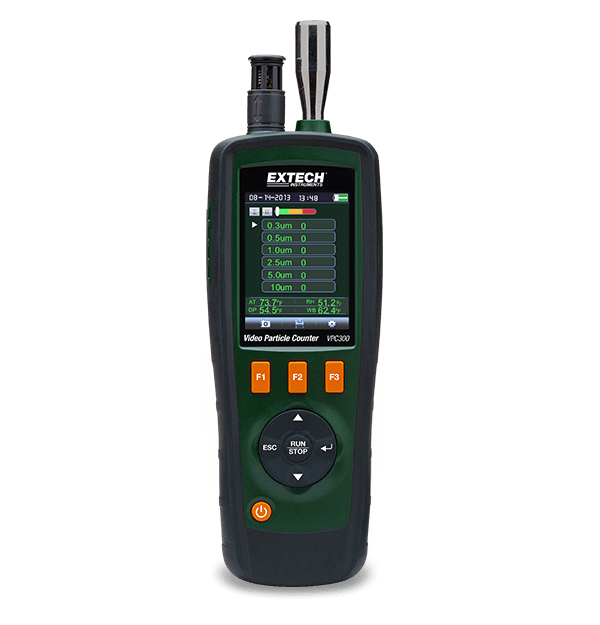
Extech VPC300 handheld video particle counter, showing its six particle-size channels on the colour display
Closest to a real measurement

Extech VPC300 Video Particle Counter

A professional HVAC instrument rather than a gadget: six size channels from 0.3 to 10 microns, a pump-controlled sample volume, a 5,000-record logger, and a NIST-traceable calibration certificate in the box. It still can't tell you a particle is plastic — but it reports air the way microplastics papers do, as counts resolved by size.

Key specs
  • Method: laser scattering particle counter; 6 channels at 0.3, 0.5, 1.0, 2.5, 5.0 and 10 microns
  • Flow rate 2.83 L/min (0.1 ft³/min) via internal pump; cumulative, differential and concentration readouts
  • Stores 5,000 records with date, time, counts, temperature, humidity and location labels, plus 20 minutes of video
  • Also reads air temperature, relative humidity, dew point and wet bulb; ships with a NIST-traceable calibration certificate, tripod and hard case

Pros

  • Counts particles by size instead of estimating a mass figure — directly comparable to how the research reports concentrations
  • The 1, 2.5, 5 and 10 micron channels bracket the band where ~94% of indoor microplastics were measured
  • NIST-traceable calibration means the sizing is a checked figure rather than a marketing one
  • The logger and built-in camera make a proper before/after filter test easy to run and easy to document

Cons

  • Cannot identify a polymer — every particle is just a count, whatever it's made of
  • Professional-instrument pricing, well above every consumer monitor
  • Extech publishes NIST-traceable calibration but doesn't claim ISO 21501-4, the cleanroom particle-counter standard
  • Handheld and battery-powered: it samples where you point it, rather than watching a room continuously
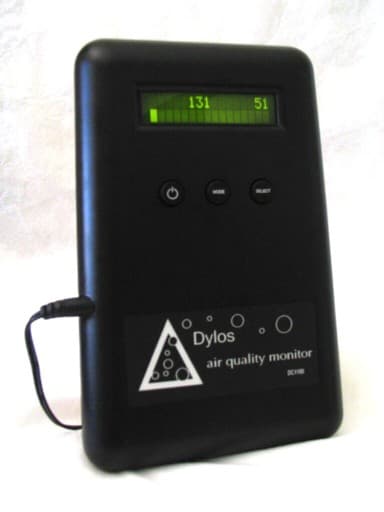
Dylos DC1100 Pro air quality monitor, a small black desktop unit with an LCD particle count display
Best for continuous monitoring

Dylos DC1100 Pro Air Quality Monitor

A plain black box that has been quietly running on shelves in citizen air-quality projects for well over a decade. Two channels, an LCD bar graph, thirty days of stored history, and no app, account, or cloud service anywhere near it. Leave it out and you learn your home's daily particle rhythm.

Key specs
  • Method: laser particle counter, 2 channels — small (≥0.5 micron) and large (≥2.5 micron)
  • LCD showing both counts with a dynamic bar graph; minute, hour, day and monitor modes
  • Stores up to 30 days of history on the device itself
  • 7 × 4.5 × 3 in, 2.5 lb, mains powered; a separate variant adds a serial PC interface for exporting data

Pros

  • Runs continuously, so you see which activities spike particles — vacuuming, laundry, cooking, opening a window
  • The large-particle channel is the one that tracks fiber-scale dust, which is what sheds off textiles
  • Long, well-documented track record in independent air-quality work
  • No phone, no account, no subscription: it displays a number and stores its own history

Cons

  • Two channels only — no size distribution, just "small" and "large"
  • Counts particles, identifies nothing; same fundamental limit as everything else here
  • Dated hardware, and data export needs the separately sold serial-interface version
  • Supply is intermittent — it goes on backorder for long stretches
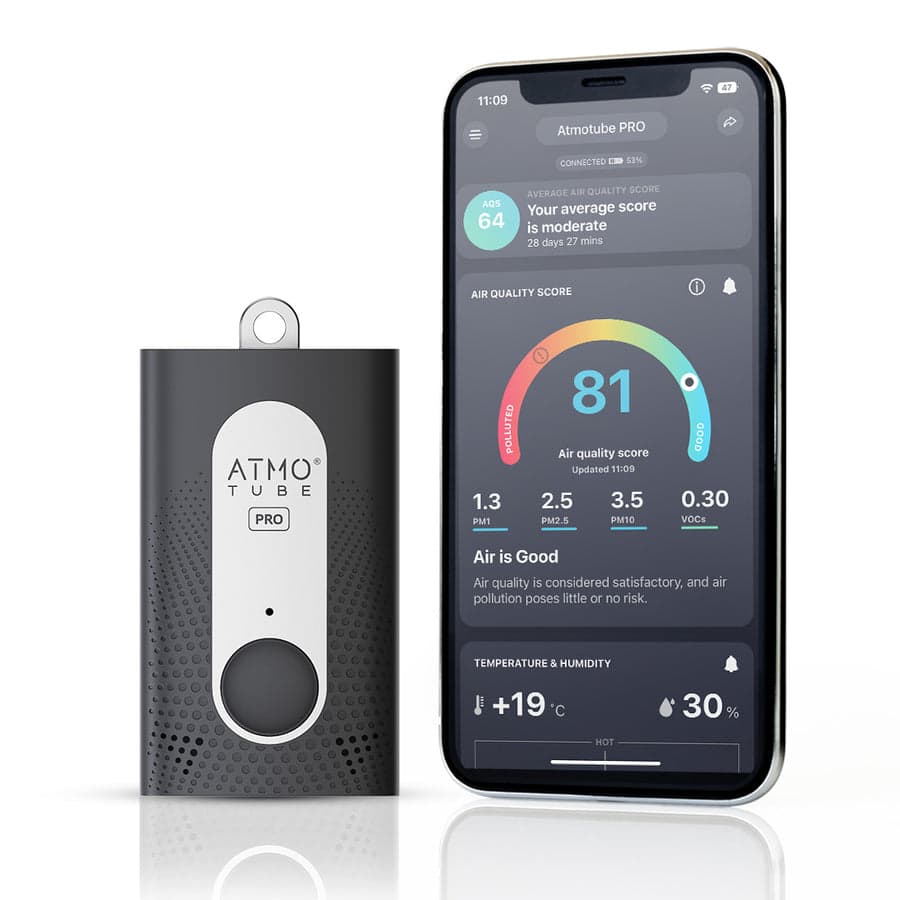
Atmotube PRO portable air quality monitor, a small dark handheld device with a clip
Best portable

Atmotube PRO Portable Air Quality Monitor

Pocket-sized, clips to a bag, logs to your phone. Technically the weakest instrument on this page — it reports estimated mass, not counts — but it's the only one that goes where you go, and the highest indoor microplastic concentrations ever measured were in car cabins, not living rooms.

Key specs
  • Method: optical PM sensor reporting PM1, PM2.5 and PM10 as estimated mass (µg/m³)
  • Also measures total VOCs, temperature, humidity and barometric pressure
  • Bluetooth to a phone app with logging, history and map view
  • Pocket or bag-clip size, rechargeable, multi-day battery

Pros

  • Portable, so you can check the car, the office, and the commute — not just one room
  • Good at the practical question of which rooms and which activities spike particles
  • Cheapest of the three by a wide margin
  • VOC channel is a useful side benefit around new plastics and furnishings, which offgas

Cons

  • Reports estimated mass rather than particle counts — the weakest match to how microplastics are actually measured
  • PM10 is its ceiling, so larger fibers are invisible to it entirely
  • Optical PM sensors assume roughly spherical particles; elongated fibers break that assumption and are under-counted
  • Needs the phone app for anything past a glance at the current reading

Before you buy

No consumer device identifies plastic in air

This is the same limitation as the home water test kits: telling plastic from cellulose or mineral dust requires FTIR or Raman spectroscopy on a captured sample. Every instrument on this page counts or weighs particles and stops there. If a product advertises "microplastic detection" in air, it is counting particles and calling them plastic.

Counts beat mass for this particular job

Research reports airborne microplastics as particles per cubic metre. A PM2.5 monitor reports micrograms per cubic metre, inferred from scattered light by assuming a particle density and shape. Both assumptions fail for a long thin fiber. A counter that reports how many particles it saw in each size band is closer to the literature than any mass figure.

Fibers are the blind spot in all of them

Optical sensors size a particle by how it scatters light, treating it as a sphere. A polyester fiber 200 microns long and 15 across can read far smaller than it is, or fall outside the size cut altogether. Every device here under-represents fibers, which are the dominant indoor microplastic shape — read any number you get as a lower bound.

If you're choosing between a monitor and a filter, buy the filter

A monitor changes nothing about your air. It earns its price only if you'll actually run the test: baseline the room, run a purifier, compare the same channels at the same fan speed and door position. If that isn't going to happen, put the money into a True HEPA purifier and skip the instrument.

Related reading