Blog
Microplastics in Table Salt: What Studies Have Found
By Timothy Dunbar · · 4 min read · Updated
Salt is evaporated water — sea water, lake water, or ancient brine trapped underground — so it's a reasonable place to look for whatever was dissolved or suspended in that water to begin with, including plastic. Several independent research teams have looked, in different countries, using different methods, and the results largely agree with each other.

The China study that started the wave
In 2015, researchers bought 15 salt brands from Chinese supermarkets — sea salt, lake salt, and rock/well salt — and analyzed them for microplastic content. Every single sample contained some. Sea salts had the most, at 550–681 particles per kilogram; lake salts ranged from 43–364 particles/kg; rock and well salts, drawn from underground deposits rather than open water, had the least, at 7–204 particles/kg (Yang et al., 2015, Environmental Science & Technology). Fragments and fibers dominated, and most particles were under 200 micrometers — smaller than a human hair is wide.
Particles per kilogram. Solid to the lowest brand measured, lighter to the highest.
15 brands bought from Chinese supermarkets. Every sample contained microplastic.Source: Yang et al., 2015, Environmental Science & Technology
The ranking — sea salt highest, rock salt lowest — has been the most consistently replicated pattern in this field, and it makes physical sense: sea salt is made by evaporating open ocean water that's been mixing with surface pollution for years, while rock salt was often deposited millions of years ago, before plastic existed.
Confirmation from the US
A 2018 study from the same research group behind well-known bottled water testing looked at U.S. tap water, beer, and 12 brands of commercial sea salt. Every salt brand tested contained microplastic, with counts ranging up to the hundreds of particles per kilogram and fibers making up the large majority of particles found — consistent with fibers being the most common microplastic shape in tap water and air as well (Kosuth, Mason & Wattenberg, 2018, PLOS ONE). A broader 2018 global review pooling studies from multiple countries similarly found microplastic in over 90% of table salt brands sampled worldwide, across sea, lake, and rock salt varieties (Kim et al., 2018, Environmental Science & Technology).
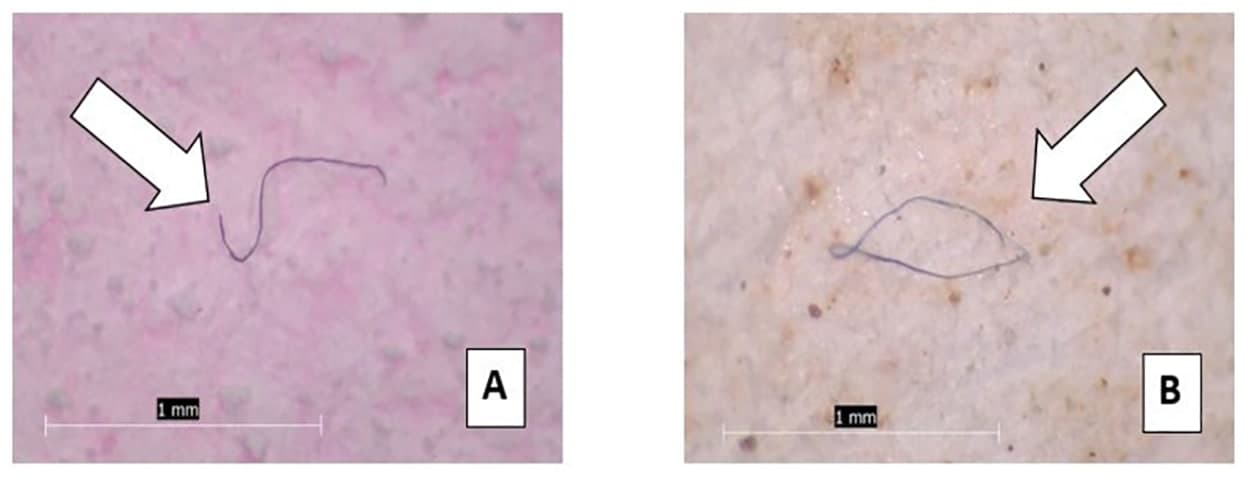
The geographic pattern in that global review is worth knowing: salt from regions with heavier plastic pollution in nearby waters — much of Asia — tended to test higher than salt from Europe, North America, or Australia. Salt contamination broadly tracks the health of the water it came from.
How much does this actually add to your exposure?
This is the part headlines usually skip. Do the arithmetic and salt turns out to be a minor contributor. The average adult consumes roughly 8–10 grams of salt a day. At even the higher end of measured contamination — call it 600 particles per kilogram — that's on the order of 5–6 microplastic particles a day from salt. Compare that to bottled water, where a single liter can carry hundreds of particles, or a single plastic tea bag, which the McGill study found releases billions of particles into one cup. Salt is real, well-documented contamination — and also one of the smallest slices of the daily-intake pie for anyone who cares to prioritize.
What to actually do
Given the relative size of the exposure, this is a low-stakes decision:
- If you're going to make one change, favor rock, well, or mined salt over sea salt — the research consistently shows it tests lowest, and the difference (Himalayan pink salt, for instance, is a rock salt) costs nothing extra in most stores.
- Don't bother trying to "filter" or rinse salt — there's no practical home method, and the quantities involved don't justify the effort.
- Spend your attention budget elsewhere first. If you haven't already switched from bottled to filtered tap water or stopped microwaving food in plastic, those steps move far more particles than a salt swap does. See where microplastics come from for the full ranked list.
Salt is a good example of why this site tries to report contamination findings alongside their actual scale: yes, it's in there, and no, it isn't where your effort is best spent.
This article describes research findings and general information, not personalized health advice.