Blog
Does Boiling Water Remove Microplastics?
By Timothy Dunbar · · 6 min read · Updated
Boiling water kills pathogens, so it's natural to assume it "purifies" water in general. With microplastics, the honest answer is more interesting than a simple yes or no: boiling does nothing to destroy microplastics, but in hard water it may remove a meaningful share of them — by accident.
The study everyone is citing
In 2024, researchers from Guangzhou Medical University and Jinan University published a widely covered study in Environmental Science & Technology Letters (Yu et al., 2024). They spiked tap water samples with nano- and microplastics, boiled them for five minutes, let them cool, and measured what remained suspended in the water.
The headline result: in hard water (rich in dissolved calcium carbonate), boiling removed up to roughly 80–90% of the spiked particles. In soft water, removal was far lower — around 25% or less.
Share of spiked micro- and nanoplastic particles removed after five minutes of boiling. Solid to the lower estimate, lighter to the upper.
Removed, not destroyed: the particles are bound into limescale, which then has to be decanted or filtered away.Source: Yu et al., 2024, Environmental Science & Technology Letters
Why hardness is the whole story
The mechanism isn't the heat attacking the plastic — plastic doesn't break down at 100 °C. It's limescale.
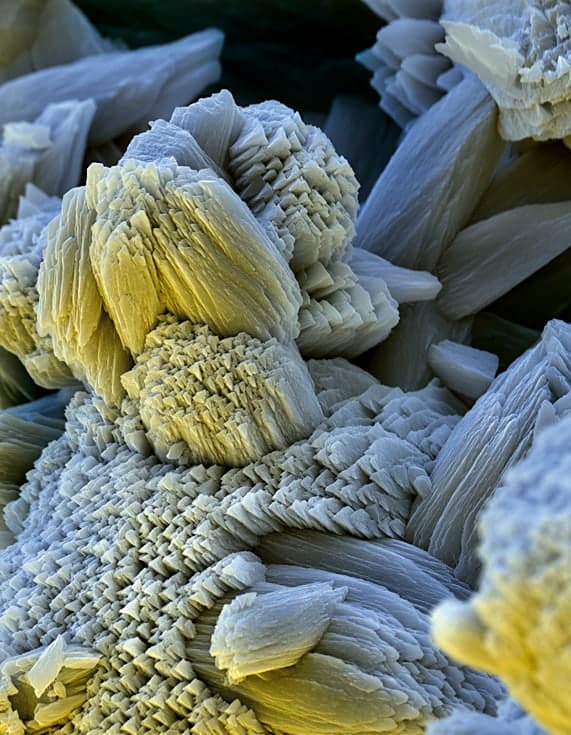
When hard water boils, dissolved calcium carbonate comes out of solution and crystallizes — the familiar white scale that coats kettles. The researchers found that as the scale forms, it encapsulates plastic particles, binding them into crystalline crusts that either stick to the kettle or settle out as visible flakes. Pour the water through a simple filter (they used the equivalent of a coffee filter or fine mesh) to catch the loose flakes, and the trapped plastic goes with it.
That makes the findings very dependent on your local water:
- Hard water areas (much of the American Midwest and Southwest, large parts of England): boiling + settling + a simple pour-through filter may remove a large fraction of microplastics.
- Soft water areas (much of the U.S. Pacific Northwest and New England, Scotland): little calcium carbonate, little encapsulation, little removal.
If your kettle builds up scale quickly, you have hard water. If it stays clean for months, you likely don't — and this trick won't do much for you.
What the published Comment argues
The study drew a formal Comment in the same journal from Robert Hale and Bayleigh Albert of the Virginia Institute of Marine Science, and a response from the original authors.
It's worth being precise about what that Comment does and doesn't say, because "study challenged" reads more dramatically than the substance. Hale and Albert do not dispute that boiling removes particles from hard water. They call the approach "novel and promising" and its simplicity "meritorious." Their objection is about what happens around the edges of it.
A water softener can cancel the effect. Softeners strip out the calcium that does the work, and they're most common precisely in hard-water areas — the households that would otherwise benefit most. The Comment adds two riders: softeners are themselves typically built of plastic, and the ion exchange consumes 18–23 kg of salt a month, while salt itself has measured microplastic content.
Boiling may accelerate the leaching of plastic additives. This is the more consequential point. Plastics carry additives — phthalate plasticizers, flame retardants, processing aids — some present at percent levels, and how fast they escape a particle depends partly on the polymer's glass transition temperature, the point where it shifts from glassy to rubbery. Water boils at 100 °C. Representative values the Comment cites: nylon-6,6 around 50 °C, PET around 70 °C, PVC around 90 °C, polystyrene and ABS around 100 °C. Boiling takes several common polymers through that transition, and the turbulence of a boil speeds diffusion away from the particle surface as well.
Note what this is: a mechanistic argument that boiling could increase additive release, not a measurement showing that it does. Hale and Albert report no experiment on it — and Hale confirmed that reading for this article:
The Comment set out a mechanistic argument that boiling could accelerate additive release from micro- and nanoplastics. It did not report measurements at boiling temperature.
— Robert C. Hale, Virginia Institute of Marine Science, in correspondence, September 2026
But it complicates the simple reading of the original result, because the thing being counted — particles — is not the only thing that matters to health. Fewer particles and more dissolved additives is not obviously a win.
The catches
Before you make boiling your microplastics strategy, some honest caveats:
- It's one lab study. The experiment used spiked simulated tap water and controlled conditions, and replication with real-world water and different particle types is still thin. Treat the exact percentages as promising, not settled — and read the two provisos above alongside them.
- You must remove the water from the scale. The plastic isn't destroyed — it's stuck to precipitated minerals. Drink from a heavily scaled kettle where flakes are breaking loose into your cup and you may be undoing the benefit. Decant the water, filter out flakes, and descale the kettle regularly (discarding the scale, not drinking it).
- Boil in metal or glass, not plastic. Separate research has measured plastic kettles releasing microplastics during boiling — millions of particles per liter from polypropylene kettles (Shi et al., 2022, Journal of Hazardous Materials). Boiling water in a plastic kettle to remove microplastics is working against yourself. An all-stainless or glass kettle avoids this — we cover options in kitchen swaps.
- Boiling doesn't touch anything else plastic-related. Dissolved plasticizer chemicals, PFAS, lead — none of these are removed by boiling. Boiling actually concentrates dissolved contaminants slightly as water evaporates.
So what's the practical verdict?
If you already boil your drinking water — as hundreds of millions of households worldwide do by habit or culture — the research suggests you may be getting free microplastic reduction, especially in hard water areas. Use a non-plastic kettle, let the water settle, pour through a fine filter, descale regularly. Two qualifications from the Comment above: if your home has a water softener, expect little benefit, because the calcium that does the work has been removed; and treat this as a demonstrated reduction in particle count, not a demonstrated health benefit, given the open question about additive release.
If you don't already boil, boiling solely for microplastics is hard to recommend: it costs energy and time, its effectiveness swings wildly with water hardness, and a certified filter is more consistent. A reverse osmosis system or an NSF/ANSI 401-certified filter removes particles mechanically regardless of your water chemistry — see our water filter guide for what to look for.
And whichever route you take, it beats bottled water on the evidence we have: bottled water has repeatedly tested substantially higher for microplastics than tap (Mason et al., 2018).
This article describes research findings and general information, not personalized health advice.
Frequently asked questions
Does boiling water remove microplastics?
In hard water, a 2024 study found boiling for five minutes trapped up to 80–90% of spiked microplastic particles in the limescale that forms, but in soft water removal dropped to around 25% or less. The plastic isn't destroyed — it's bound into the scale, so the water needs to be decanted and filtered away from it.
Does boiling work the same in soft water areas?
No. The mechanism depends on dissolved calcium carbonate crystallizing and trapping particles as it forms. Soft water has little calcium carbonate, so far less encapsulation happens and boiling removes much less. The same applies if your home has a water softener, which removes the calcium that does the work — a published Comment on the study notes that softeners are most common in exactly the hard-water areas that would otherwise benefit.
Is boiling water in a plastic kettle a good way to reduce microplastics?
No — separate research has measured plastic kettles releasing millions of microplastic particles into the water during boiling, which works against any benefit from the limescale effect. Use a stainless steel or glass kettle instead.